This website uses cookies
We use cookies to personalise content and ads, to provide social media features and to analyse our traffic. We also share information about your use of our site with our social media, advertising and analytics partners who may combine it with other information that you’ve provided to them or that they’ve collected from your use of their services.
Consent Selection
Details
  • Necessary cookies help make a website usable by enabling basic functions like page navigation and access to secure areas of the website. The website cannot function properly without these cookies.
    • Learn more about this provideropens in a new window
      CookieConsentStores the user's cookie consent state for the current domain
      Maximum Storage Duration: 1 yearType: HTTP Cookie
    • Learn more about this provideropens in a new window

      Some of the data collected by this provider is for the purposes of personalization and measuring advertising effectiveness. The provider may use the IP Addresses for ads measurement and ads personalization.

      test_cookieUsed to check if the user's browser supports cookies.
      Maximum Storage Duration: 1 dayType: HTTP Cookie
    • Learn more about this provideropens in a new window
      __cf_bmThis cookie is used to distinguish between humans and bots. This is beneficial for the website, in order to make valid reports on the use of their website.
      Maximum Storage Duration: 1 dayType: HTTP Cookie
      cf_clearanceThis cookie is used to distinguish between humans and bots.
      Maximum Storage Duration: 1 yearType: HTTP Cookie
  • Preference cookies enable a website to remember information that changes the way the website behaves or looks, like your preferred language or the region that you are in.
    • We do not use cookies of this type.

  • Statistic cookies help website owners to understand how visitors interact with websites by collecting and reporting information anonymously.
    • Learn more about this provideropens in a new window
      p.gifKeeps track of special fonts used on the website for internal analysis. The cookie does not register any visitor data.
      Maximum Storage Duration: SessionType: Pixel Tracker
    • Learn more about this provideropens in a new window

      Some of the data collected by this provider is for the purposes of personalization and measuring advertising effectiveness. The provider may use the IP Addresses for ads measurement and ads personalization.

      _gaUsed to send data to Google Analytics about the visitor's device and behavior. Tracks the visitor across devices and marketing channels.
      Maximum Storage Duration: 2 yearsType: HTTP Cookie
      _ga_#Used to send data to Google Analytics about the visitor's device and behavior. Tracks the visitor across devices and marketing channels.
      Maximum Storage Duration: 2 yearsType: HTTP Cookie
  • Marketing cookies are used to track visitors across websites. The intention is to display ads that are relevant and engaging for the individual user and thereby more valuable for publishers and third party advertisers.
    • Learn more about this provideropens in a new window

      Some of the data collected by this provider is for the purposes of personalization and measuring advertising effectiveness. The provider may use the IP Addresses for ads measurement and ads personalization.

      pagead/1p-user-list/#Tracks if the user has shown interest in specific products or events across multiple websites and detects how the user navigates between sites. This is used for measurement of advertisement efforts and facilitates payment of referral-fees between websites.
      Maximum Storage Duration: SessionType: Pixel Tracker
      _gcl_auUsed to measure the efficiency of the website’s advertisement efforts, by collecting data on the conversion rate of the website’s ads across multiple websites.
      Maximum Storage Duration: 3 monthsType: HTTP Cookie
      _gcl_lsTracks the conversion rate between the user and the advertisement banners on the website - This serves to optimise the relevance of the advertisements on the website.
      Maximum Storage Duration: PersistentType: HTML Local Storage
    • Learn more about this provideropens in a new window
      __cf_obPending
      Maximum Storage Duration: SessionType: HTTP Cookie
      _cfPre_tabIdPending
      Maximum Storage Duration: SessionType: HTML Local Storage
    • Learn more about this provideropens in a new window
      __Secure-ROLLOUT_TOKENUsed to track user’s interaction with embedded content.
      Maximum Storage Duration: 180 daysType: HTTP Cookie
      __Secure-YECStores the user's video player preferences using embedded YouTube video
      Maximum Storage Duration: SessionType: HTTP Cookie
      __Secure-YNIDUsed to track user’s interaction with embedded content.
      Maximum Storage Duration: 180 daysType: HTTP Cookie
      LAST_RESULT_ENTRY_KEYUsed to track user’s interaction with embedded content.
      Maximum Storage Duration: SessionType: HTTP Cookie
      LogsDatabaseV2:V#||LogsRequestsStoreUsed to track user’s interaction with embedded content.
      Maximum Storage Duration: PersistentType: IndexedDB
      TESTCOOKIESENABLEDUsed to track user’s interaction with embedded content.
      Maximum Storage Duration: 1 dayType: HTTP Cookie
      VISITOR_INFO1_LIVETries to estimate the users' bandwidth on pages with integrated YouTube videos.
      Maximum Storage Duration: 180 daysType: HTTP Cookie
      YSCRegisters a unique ID to keep statistics of what videos from YouTube the user has seen.
      Maximum Storage Duration: SessionType: HTTP Cookie
      yt-icons-last-purgedNecessary for the implementation and functionality of YouTube video-content on the website.
      Maximum Storage Duration: PersistentType: HTML Local Storage
      ytidb::LAST_RESULT_ENTRY_KEYUsed to track user’s interaction with embedded content.
      Maximum Storage Duration: PersistentType: HTML Local Storage
      YtIdbMeta#databasesUsed to track user’s interaction with embedded content.
      Maximum Storage Duration: PersistentType: IndexedDB
  • Unclassified cookies are cookies that we are in the process of classifying, together with the providers of individual cookies.
    • matrix_last_commercial_productPending
      Maximum Storage Duration: SessionType: HTML Local Storage
Cookie declaration last updated on 10/29/26 by Cookiebot
[#IABV2_TITLE#]
[#IABV2_BODY_INTRO#]
[#IABV2_BODY_LEGITIMATE_INTEREST_INTRO#]
[#IABV2_BODY_PREFERENCE_INTRO#]
[#IABV2_BODY_PURPOSES_INTRO#]
[#IABV2_BODY_PURPOSES#]
[#IABV2_BODY_FEATURES_INTRO#]
[#IABV2_BODY_FEATURES#]
[#IABV2_BODY_PARTNERS_INTRO#]
[#IABV2_BODY_PARTNERS#]
About
Cookies are small text files that can be used by websites to make a user's experience more efficient.

The law states that we can store cookies on your device if they are strictly necessary for the operation of this site. For all other types of cookies we need your permission.

This site uses different types of cookies. Some cookies are placed by third party services that appear on our pages.

You can at any time change or withdraw your consent from the Cookie Declaration on our website.

Learn more about who we are, how you can contact us and how we process personal data in our Privacy Policy.

Please state your consent ID and date when you contact us regarding your consent.

Turning Member Data Into Workout Direction with AI

June 8, 2026

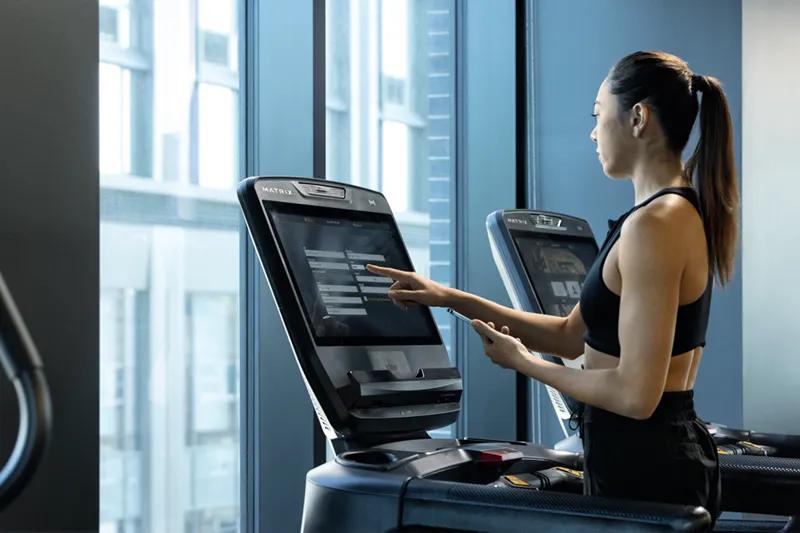
A person in workout clothing on a treadmill touching the console screen

The illusion of progress

The fitness industry has no shortage of data. Members can track heart rate, output, body composition, workout history, and more across wearables and apps. Yet one problem still shows up on the training floor. Many members start a workout without knowing what to do next.

That gap stands out because the industry has already solved for visibility. Data is everywhere. Direction is not. Members can see the numbers, but they still have to decide where to start, how hard to push, what weight to use, and how to adjust during the workout.

This is why AI has become a bigger part of the conversation. The value of AI in fitness is not speed or novelty. Its value is in turning large volumes of data into guidance people can use in the moment.
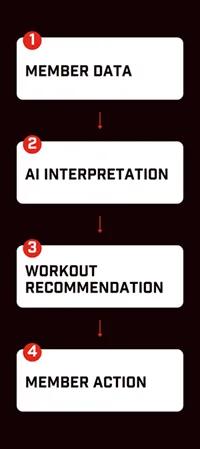
The missing step between insight and action

The first few visits are often full of uncertainty, especially for new exercisers. Research on novice exercisers reported attendance rates of 10 to 37% in the first months after joining. Nearly half of adults report feeling intimidated in gym settings, with fear of judgment limiting participation. When people walk into a facility and face one decision after another without enough support, hesitation is a predictable result.

Many systems still stop at measurement. They report what happened, but they do not guide what should happen next. That leaves members to interpret the data on their own or depend on whether someone is available to help. On a busy floor, that creates friction where support is needed most.

AI can help close that gap. It can take individual inputs, compare them over time, and turn them into useful direction during the session. That changes the role of data from passive feedback to active guidance.

Why current approaches fall short

A big part of the issue comes down to how exercise guidance is still delivered. Much of the industry leans on broad recommendations that do not reflect the individual in front of the screen. Readiness, preferences, goals, and physical condition vary from one member to the next, yet many programs still start from a generic model.

Someone who needs a simple starting point and a plan they can follow is not helped by a one-size-fits-all workout. Personalized guidance tends to support better adherence because it gives people something relevant and doable.

AI stands apart from static programming. It can adapt as new inputs come in. It can respond to performance, behavior, and progression across sessions. It can support a training experience that changes with the member instead of asking the member to fit a fixed plan.

There is another factor too. Workouts do not happen in ideal conditions. They happen in busy facilities with shared equipment, limited time, and different levels of staff support. A workout can look efficient in theory and still fall apart on the floor. AI has to work in that environment to be useful. That is the standard the industry should expect.

What the industry needs next

The next shift is about using the information already available in a way that helps people act on it from their first visit.

AI is starting to play a bigger role in that shift. Used well, it can reduce guesswork, support better decisions, and make personalization across the floor easier to deliver.

That does not remove the human side of training. Members still respond to encouragement, reassurance, and connection. A coach or staff member can influence whether someone feels comfortable enough to stay with a program and return for the next session. AI can guide the workout. People still influence the experience around it.

What comes next will not be defined by how much data the industry can collect. It will be defined by how well that data helps people train.

Matt McConley

Senior Digital Product Manager - Global Marketing

Headshot of Matt McConley smiling in a nice suit